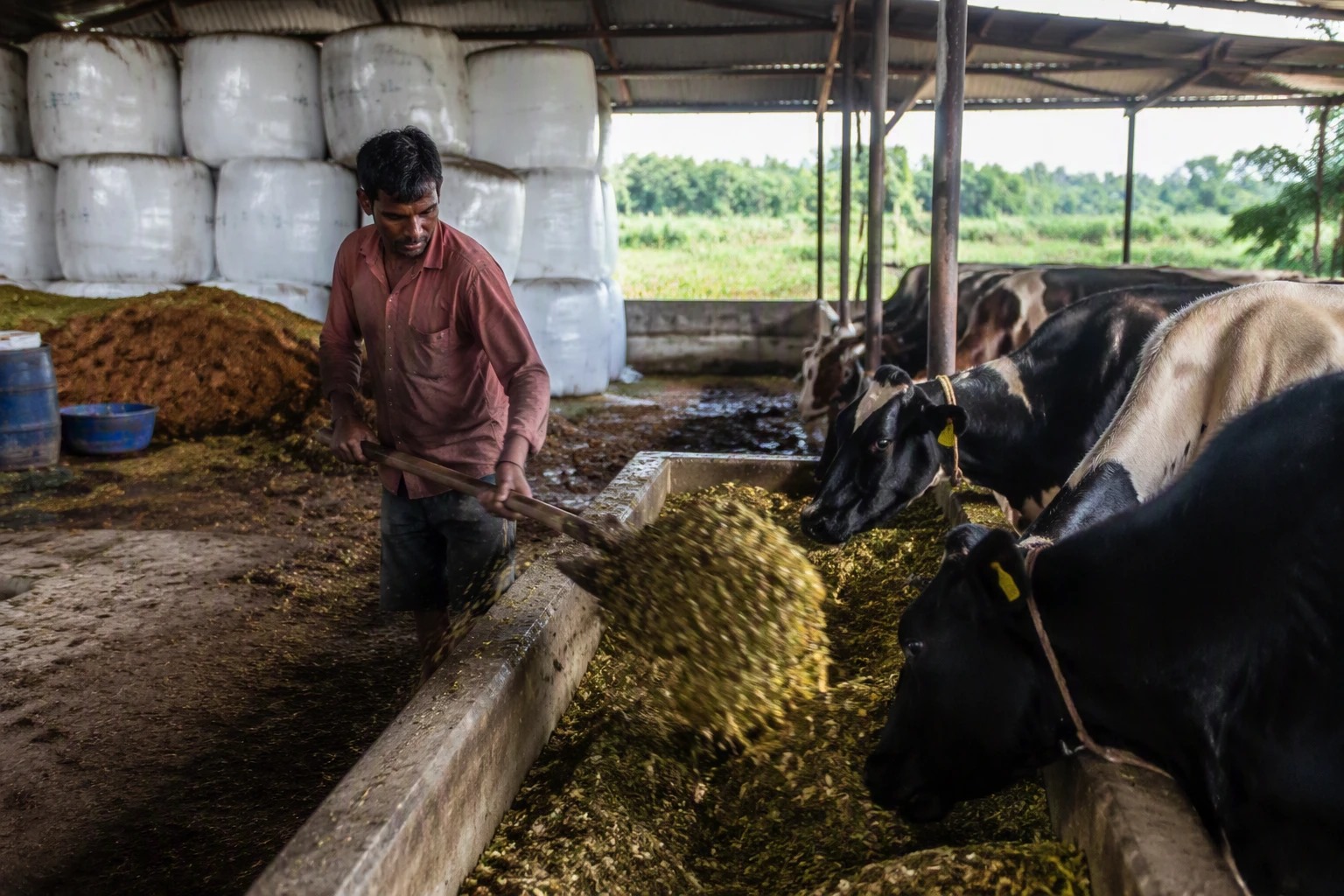
Ask ten farmers what they feed a cow giving ten litres a day and you will get ten answers. There is a published one.
ICAR's National Institute of Animal Nutrition and Physiology (NIANP) in Bengaluru issued a ready reckoner for a 400 kg crossbred cow. For each level of milk yield it shows how much concentrate, green fodder and dry fodder to offer. Here is how to read it, and what it quietly says about the economics of feed.
The chart in one table
Concentrate mixture, kg per day, for a 400 kg crossbred cow, by milk yield and the green fodder available.
| Milk yield (litres/day) | Plenty of green (35 kg) | Moderate green (20 kg) | Scarce green (2 kg) |
|---|---|---|---|
| 5 | 0 | 1.8 | 5.3 |
| 7.5 | 1.2 | 3.0 | 6.8 |
| 10 | 2.4 | 4.2 | 8.0 |
| 12.5 | 3.6 | 5.5 | 8.8 |
| 15 | 4.8 | 6.7 | 9.8 |
| 20 | 7.0 | 9.3 | 12.0 |
Source: ICAR-NIANP, Feed Chart for Feeding of Crossbred Dairy Cow (January 2013). Green fodder quantities are the amounts available per day in each column.
At 20 litres the “plenty of green” column uses 38 kg of green fodder. Dry fodder such as straw stays between 3 and 5 kg a day throughout.
Three things the chart tells you
1. Green fodder is not free feed. It is worth the concentrate it replaces.
Moving from the plenty-of-green column to the scarce-green column removes about 33 kg of green fodder and adds 5 to 5.6 kg of concentrate, at every yield on the chart. Put another way, about six kilograms of green fodder do the work of one kilogram of concentrate. If your concentrate costs ₹25 a kilo (an illustrative price; use your own), a kilo of good green fodder is worth about ₹4 to you.
2. Summer is a feed-cost event.
The scarce-green column is the dry-season ration. For a ten-litre cow it means 8 kg of concentrate instead of 2.4 kg. At ₹25 a kilo, that is roughly ₹140 more per cow per day. A farm that can store green fodder as silage and feed it through the dry months avoids that bill.
| Green fodder available | Concentrate (kg/day) | Illustrative cost at ₹25/kg (₹/day) |
|---|---|---|
| Plenty (35 kg) | 2.4 | 60 |
| Moderate (20 kg) | 4.2 | 105 |
| Scarce (2 kg) | 8.0 | 200 |
Concentrate quantities from the ICAR-NIANP chart at 10 litres a day. Cost is simple arithmetic (kg × ₹25) using an illustrative price; replace ₹25 with your current local rate. Dry-season premium versus the plenty-of-green ration: ₹140 per cow per day.
3. As yield rises, concentrate does the lifting.
Dry fodder barely moves. With moderate green fodder, concentrate climbs from 1.8 kg at 5 litres to 9.3 kg at 20 litres. The higher the yield, the more precisely the concentrate has to be right.
What goes into the concentrate
NIANP gives its own recipe: 30 parts grains (maize, broken rice, bajra, sorghum or minor millets), 36 parts brans and chunnies (wheat bran, rice bran, gram chunnies), 30 parts oil cakes (cottonseed, soybean, groundnut, coconut, sunflower or til), 1.5 parts salt, 1.5 parts calcite and 1 part mineral mixture. A commercial concentrate can be used instead if it carries about 18% crude protein and at least 65% TDN. Feed the concentrate in three divided doses, and chop both green and dry fodder to about an inch.
Where the chart stops
- It is written for a 400 kg crossbred cow. Buffaloes, indigenous cattle and animals of other weights need different amounts.
- It dates from 2013 and gives quantities, not prices. Prices decide the cheapest way to reach those quantities.
- It assumes the cow eats what she is offered. In practice cows sort. They take the grain and leave the straw.
Why a mixed ration exists
That last point is the case for a Total Mixed Ration. A TMR weighs, chops and mixes the ingredients so that every mouthful carries the proportions the chart assumes. NDDB's Ration Balancing Programme reached 28.65 lakh milch animals across 18 states. It reported an average 11.8% fall in feed cost per kilo of milk and a 13.7% fall in enteric methane per kilo of milk. Most of the extra income came from spending less on feed, not from more milk.
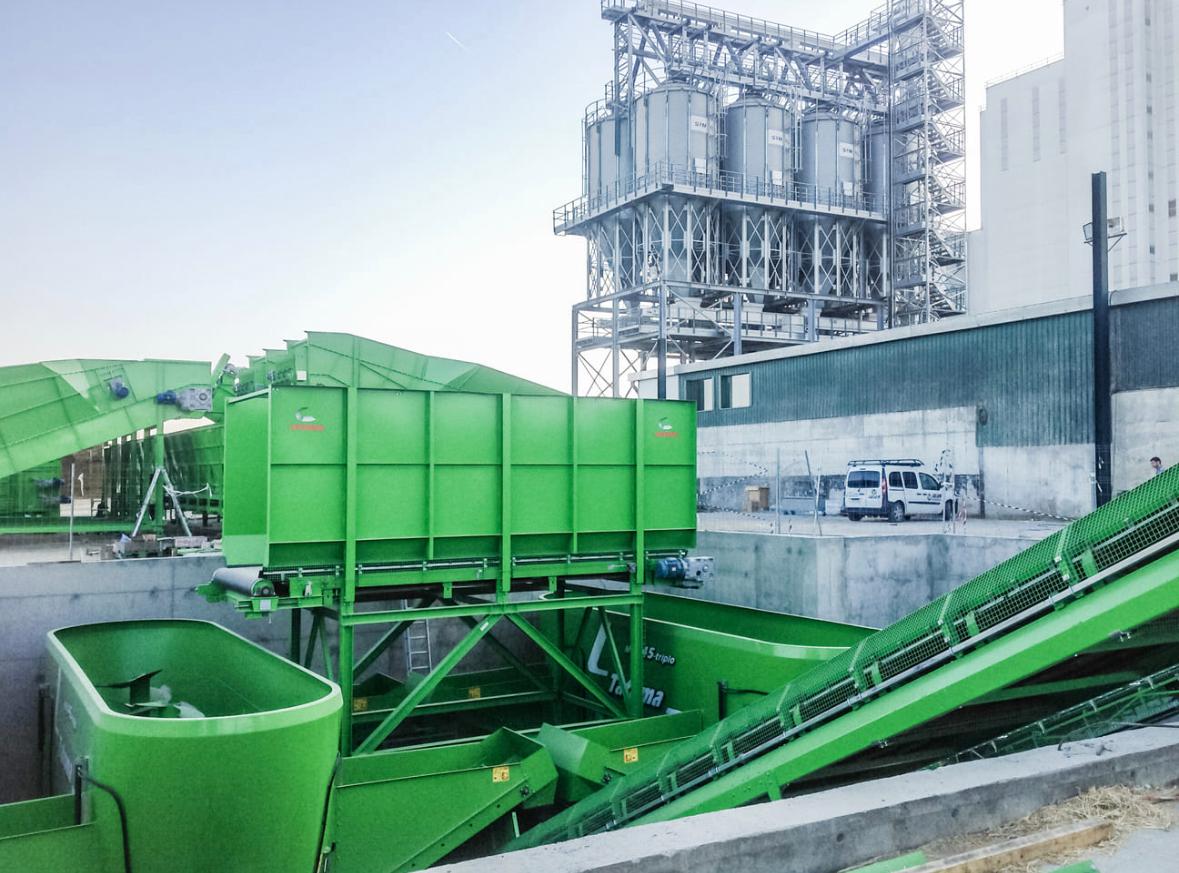
Source: NDDB, Ration Balancing Programme under the National Dairy Plan Phase-I.
Frequently asked questions
How much concentrate per litre of milk?
The chart does not use one ratio. With moderate green fodder it rises from 1.8 kg at 5 litres to 9.3 kg at 20 litres, which is roughly half a kilo more for each extra litre.
What is the minimum green fodder?
The chart states that in scarcity a minimum of 1 to 2 kg of green fodder a day is essential to keep the animal healthy.
Does this apply to buffaloes?
No. It is for crossbred cows. Ask for a buffalo-specific ration before using these numbers.
Next step
Want this turned into a daily ration for your herd, mixed and delivered? Talk to Veridia about TMR feed center plants.
Sources
- ICAR-NIANP, Feed Chart for Feeding of Crossbred Dairy Cow (January 2013).
- NDDB, Ration Balancing Programme under the National Dairy Plan Phase-I.