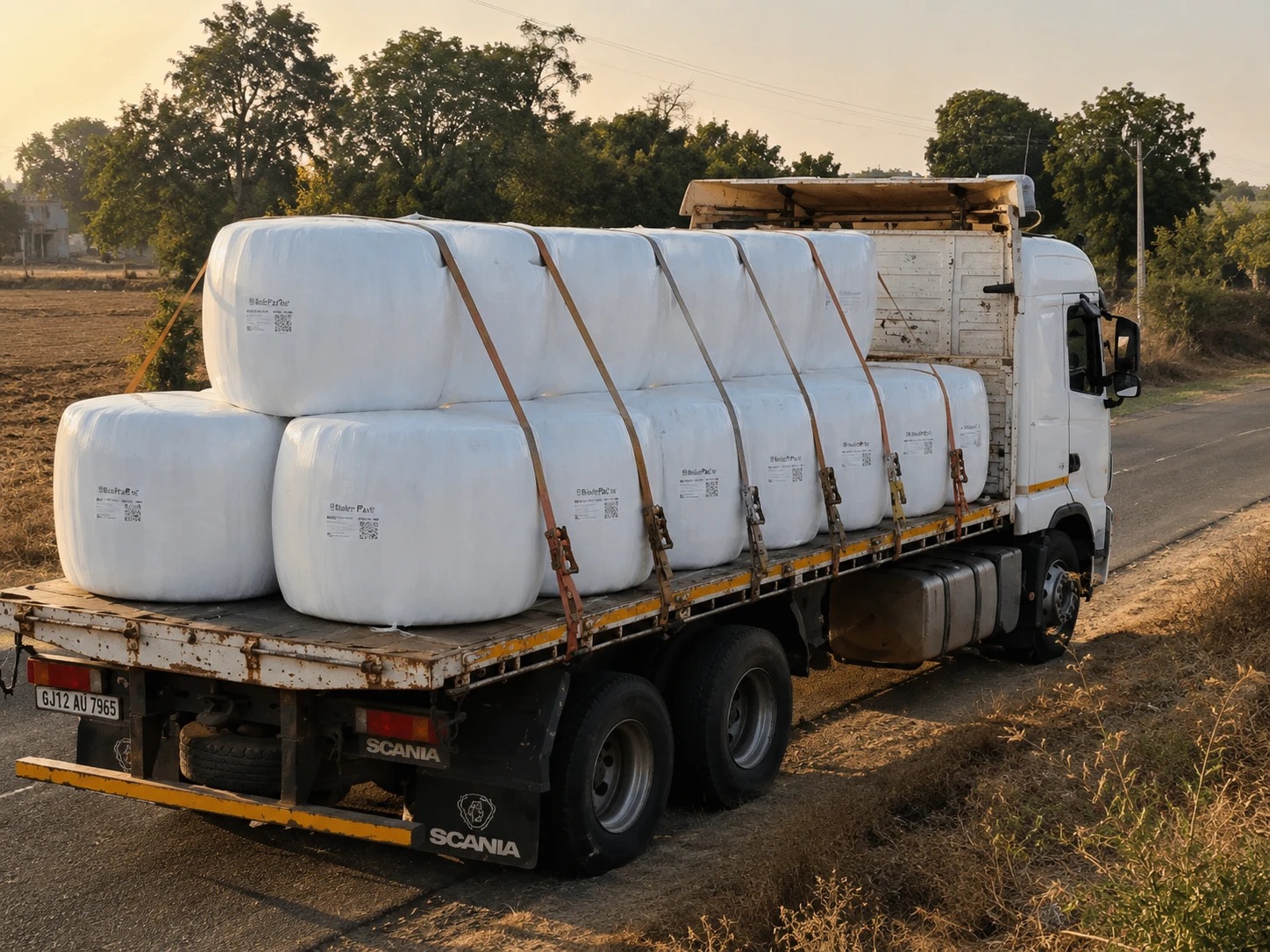
Silage does not spoil because of the crop. It spoils because of air.
The main thing that keeps air out of a pile is density, and density comes from weight. That is why one rule of thumb, the “rule of 800”, matters so much to anyone planning silage at scale in India.
Density decides loss
A frequently cited set of measurements (Ruppel, 1992, on alfalfa silage in bunkers) relates dry matter loss over 180 days to packing density. Extension guidance sets a minimum of about 14 to 15 pounds of dry matter per cubic foot.
| Density (lb DM/ft³) | About (kg DM/m³) | Dry matter lost in 180 days |
|---|---|---|
| 10 | 160 | 20.2% |
| 14 | 224 | 16.8% |
| 15 | 240 | 15.9% |
| 16 | 256 | 15.1% |
| 18 | 288 | 13.4% |
Source: Ruppel (1992), alfalfa silage in bunkers, as cited by Vita Plus.
The rule of 800
Extension services recommend at least 800 pounds (364 kg) of packing weight for every ton of fresh forage delivered to the pile per hour. Divide your tractor's weight by 364 to see how many tonnes an hour it can pack properly. A 2,500 kg tractor, a common size on Indian farms (check yours), can pack about 7 tonnes an hour. A chopper line delivering 25 tonnes an hour needs about 9 tonnes of packing weight, and one delivering 50 tonnes an hour needs about 18. For comparison, a US extension example rates a 12,000 pound (5.4 tonne) loader tractor at about 15 tonnes an hour.
| Harvest rate delivered to the pile | Packing weight needed | Reference point |
|---|---|---|
| 7 tonnes/hour | about 2.5 tonnes | A 2,500 kg tractor, common on Indian farms |
| 15 tonnes/hour | about 5.5 tonnes | US extension example: 12,000 lb (5.4 t) loader tractor |
| 25 tonnes/hour | about 9 tonnes | A chopper line delivering 25 tonnes an hour |
| 50 tonnes/hour | about 18 tonnes | A chopper line delivering 50 tonnes an hour |
Calculated as harvest rate (tonnes per hour) × 364 kg, from the extension rule of 800 pounds per ton per hour. Check the weight of your own machines.
When the harvest outruns the packer, the pile goes down loosely, oxygen stays in, and losses climb. The crop was fine. The weight was missing.
What a bale changes
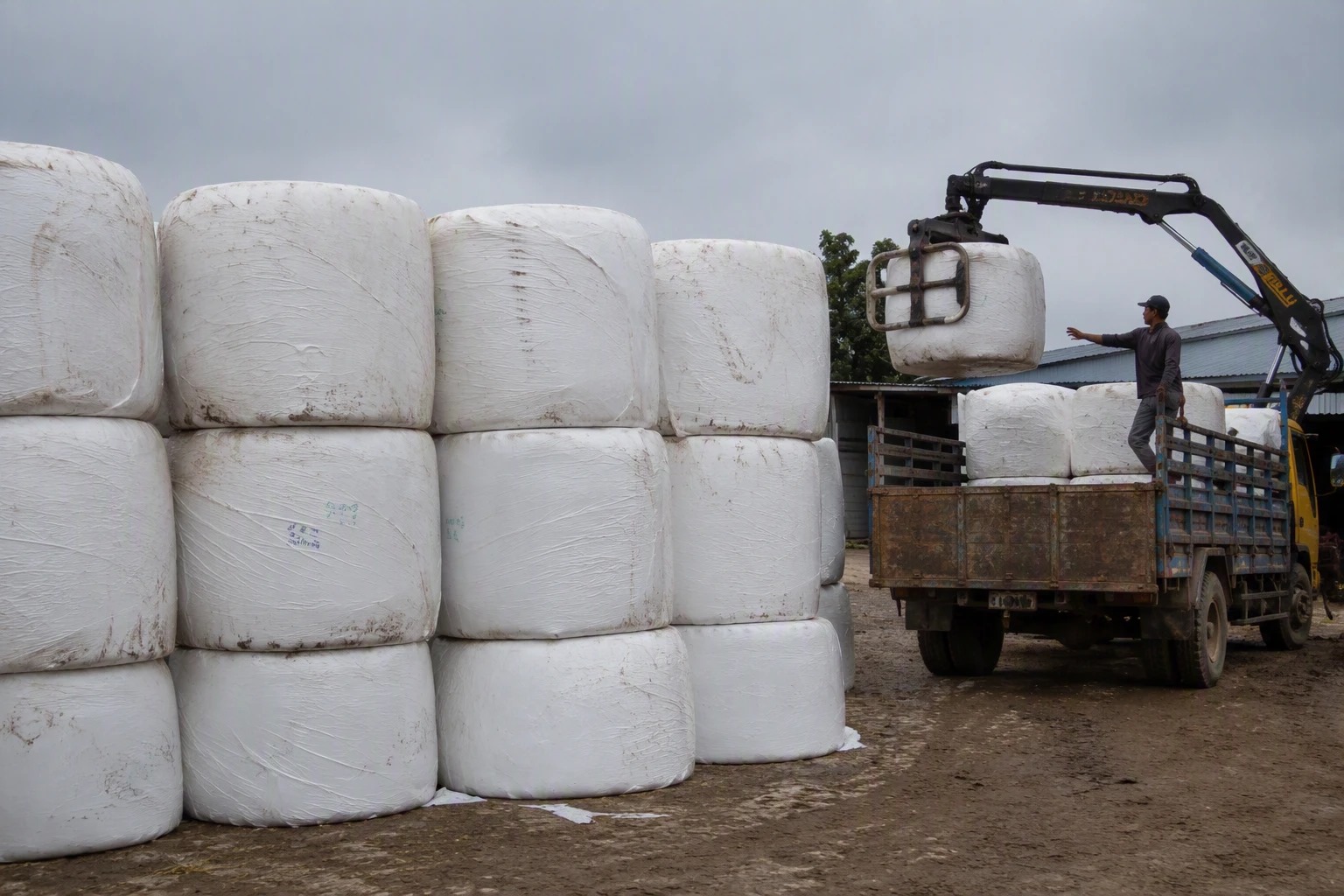
In a bale, density is set by the baler, not by the weight of a tractor driving over a pile. Published comparisons are consistent in direction, though they vary in size:
| Study | Bunker | Wrapped bale |
|---|---|---|
| Swedish farm survey (Spörndly and Nylund, 2017) | 14.1% DM lost | 1.1% |
| Swedish controlled comparison, low-DM grass | 17% total DM lost | 7% |
| USDA-ARS round-bale trial, Oklahoma | — | 6–9% estimated |
| Film meta-analysis, 10 bale comparisons | — | 7.7% standard film; 4.6% oxygen-barrier film |
Sources: Spörndly and Nylund (2017); Bunkers or round bales (ScienceDirect, 2021); USDA-ARS Publication 73020; Feedstuffs, oxygen-barrier film meta-analysis.
Across these studies well-sealed bales lost between about 1% and 9%.
The honest trade-offs
- Bales hold less fresh crop per cubic metre than a heavily packed bunker (531 against 833 kg/m³ in the Swedish comparison), so they use more film and more surface.
- Results depend on film quality, number of layers and handling. Punctures and rodents cost silage. Bales wetter than about 65% moisture showed more spoilage in US trials.
- A well-packed bunker, sealed quickly with enough weight, can perform well. The studies above are mostly from cooler climates, and we would welcome Indian field data.
A bale is also a unit you can count
A pile is a store. A bale is a product. It can be weighed, labelled, graded, moved and sold, which matters the moment silage stops being something you feed yourself and becomes something you supply to farms, TMR plants or CBG plants.
A three-step test for your site
- Work out the packing weight you needMultiply your harvest rate in tonnes per hour by 364. That is the packing weight you need, in kilograms.
- Compare it with what you haveCompare it with the heaviest machine you can keep on the pile continuously.
- Check the shortfallIf you are short by more than about a third, a bunker will under-perform unless you slow the harvest, add a second tractor or weight, or change format.
Frequently asked questions
What is the rule of 800?
At least 800 pounds (364 kg) of packing weight for each ton (tonne) of silage delivered per hour.
What density should I aim for?
At least about 14 to 15 pounds of dry matter per cubic foot (roughly 225 to 240 kg DM per cubic metre).
Are bales always better?
No. They suit operations where compaction by tractor is limited and where silage will be moved or sold. They need good film and careful handling.
Next step
Send us your harvest rate and the weight of your heaviest tractor. We will tell you which format fits, with the numbers.
Sources
- USU Extension, Chopping and Storing Quality Corn Silage.
- OSU/eXtension, Bunker Silo and Drive-Over Silage Pile Management.
- Vita Plus (Ruppel, 1992); Virginia Cooperative Extension.
- Spörndly and Nylund (2017); Bunkers or round bales (ScienceDirect, 2021).
- USDA-ARS Publication 73020; Feedstuffs, oxygen-barrier film meta-analysis.