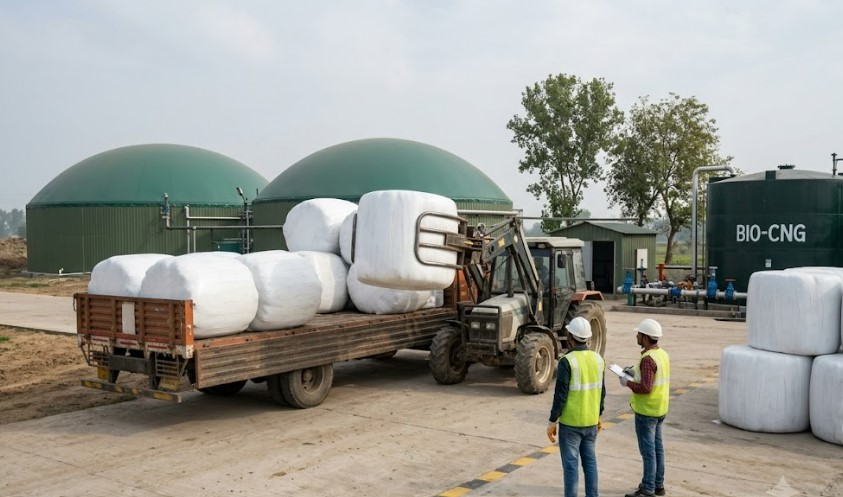
A compressed biogas (CBG) plant is built to run more than 330 days a year. The crop residues that feed many of them are harvested in a window of six to eight weeks.
That leaves more than 270 days a year in which the plant runs on feedstock harvested somewhere else, at some other time. That gap, not the reactor, is where many projects get into trouble.
The arithmetic nobody budgets for
A lender models a plant at design load. A harvest does not arrive at design load. What happens to the material between the field and the digester decides what the digester is actually fed, and therefore what the plant earns.
What open storage costs
In one study of corn stover stored outdoors as dry bales for a year, methane yield fell by 13% under cover and by 23% uncovered (Wang et al., 2019). That is the forgiving case: dry, baled material. Green, wet biomass spoils faster, because the air that rots it has more to work with.
| Storage condition | Fall in methane yield |
|---|---|
| Dry bales, under cover | 13% |
| Dry bales, uncovered | 23% |
Source: Wang et al. (2019), Effects of outdoor dry bale storage conditions on corn stover and the subsequent biogas production.
What ensiling does instead
Ensiling stores green biomass without air. Sealed, it ferments and acidifies, and that preserves it. Well-managed ensiling largely preserves methane potential, and in some studies improves it, which is why silage is a standard digester feedstock in much of Europe. For a plant that has to run all year, silage is not an agricultural detail. It is storage infrastructure.
Design the supply, not just the storage
A residue business has one harvest a year. A dedicated energy crop under irrigation has several. Hybrid Napier, for example, is cut roughly every 45 to 60 days. Reported yields vary widely by source: a published trial in Karnataka's northern dry zone recorded about 72 to 76 tonnes per hectare from the best of eight irrigated cultivars, while other agricultural university and extension sources report 100 to 200 tonnes per hectare or more for top hybrids with intensive management. The honest answer is to measure it on your land, with your water.
| Source type | Reported yield (tonnes per hectare) | Conditions |
|---|---|---|
| Karnataka northern dry zone trial | about 72–76 | Best of eight irrigated cultivars |
| Agricultural university and extension sources | 100–200 or more | Top hybrids with intensive management |
Cutting interval for hybrid Napier: roughly every 45 to 60 days. Sources: Karnataka northern dry zone hybrid Napier cultivar trial; TNAU Agritech Portal. Treat these as ranges to test locally, not as a yield promise.
Why this matters more now
GOBARdhan has underwritten the demand side. City gas distributors must blend CBG at 3% in 2026-27, 4% in 2027-28 and 5% from 2028-29, the scheme offers assured offtake for up to 100% of a plant's marketable gas, and an administered price of ₹2,110 per MMBTU is set for at least ten years. When demand and price are fixed, feedstock is what is left to go wrong.
Source: Cabinet approval of GOBARdhan, 6 August 2026. See our full explainer on GOBARdhan 2026.
The chain that results
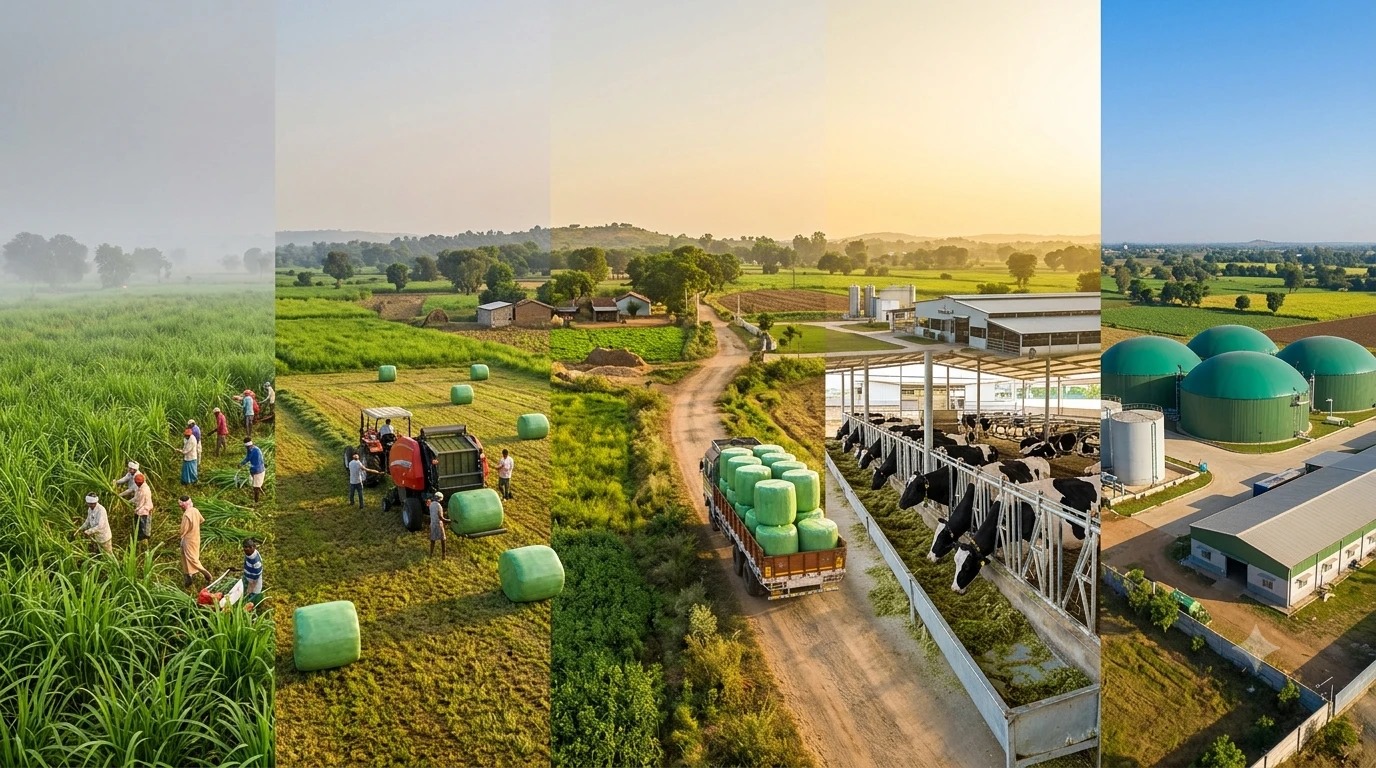
Planned harvest, then ensiling, then storage, then steady digester feed, then design load. It is simple to draw and hard to run, and it needs to be in the plan and in the capital budget from the start.
Three questions to ask before you finance a plant
- How many days of sealed feedstock will be in storage before commissioning?
- What yield, moisture and harvest calendar is the supply plan built on, and who owns that calculation?
- How will you know what you are feeding the digester: what is measured, and where?
Frequently asked questions
Why not just buy residue from the market?
You can, but spot-market residue is seasonal, variable in quality and exposed to price spikes. A plant that depends on it is trading a feedstock problem for a pricing problem.
Is silage only for energy crops?
No. Residues and surplus green biomass can be ensiled too, if they are wet enough and sealed quickly.
Next step
Planning a CBG project? Book a scoping call and we will look at your feedstock plan, harvest calendar and storage against the three questions above.
Sources
- Wang et al. (2019), Effects of outdoor dry bale storage conditions on corn stover and the subsequent biogas production.
- Karnataka northern dry zone hybrid Napier cultivar trial; TNAU Agritech Portal.
- Cabinet approval of GOBARdhan, 6 August 2026.